On this page
A form asking for the telecode of a Chinese name is asking for a character code, not its pronunciation. Typing pinyin, a phone country code or the Unicode number of the character will not answer that field. Chinese telegraph codes use four digits for each mapped character, and a leading zero is part of the code.
The practical task is to match the exact written name to the appropriate table, keep the characters in order and transfer the result in the format requested by the receiving form. The ChinaClue lookup helps with that character-by-character check. A lookup result does not decide which fields apply to your application or replace the instructions beside them.
Separate the different name fields
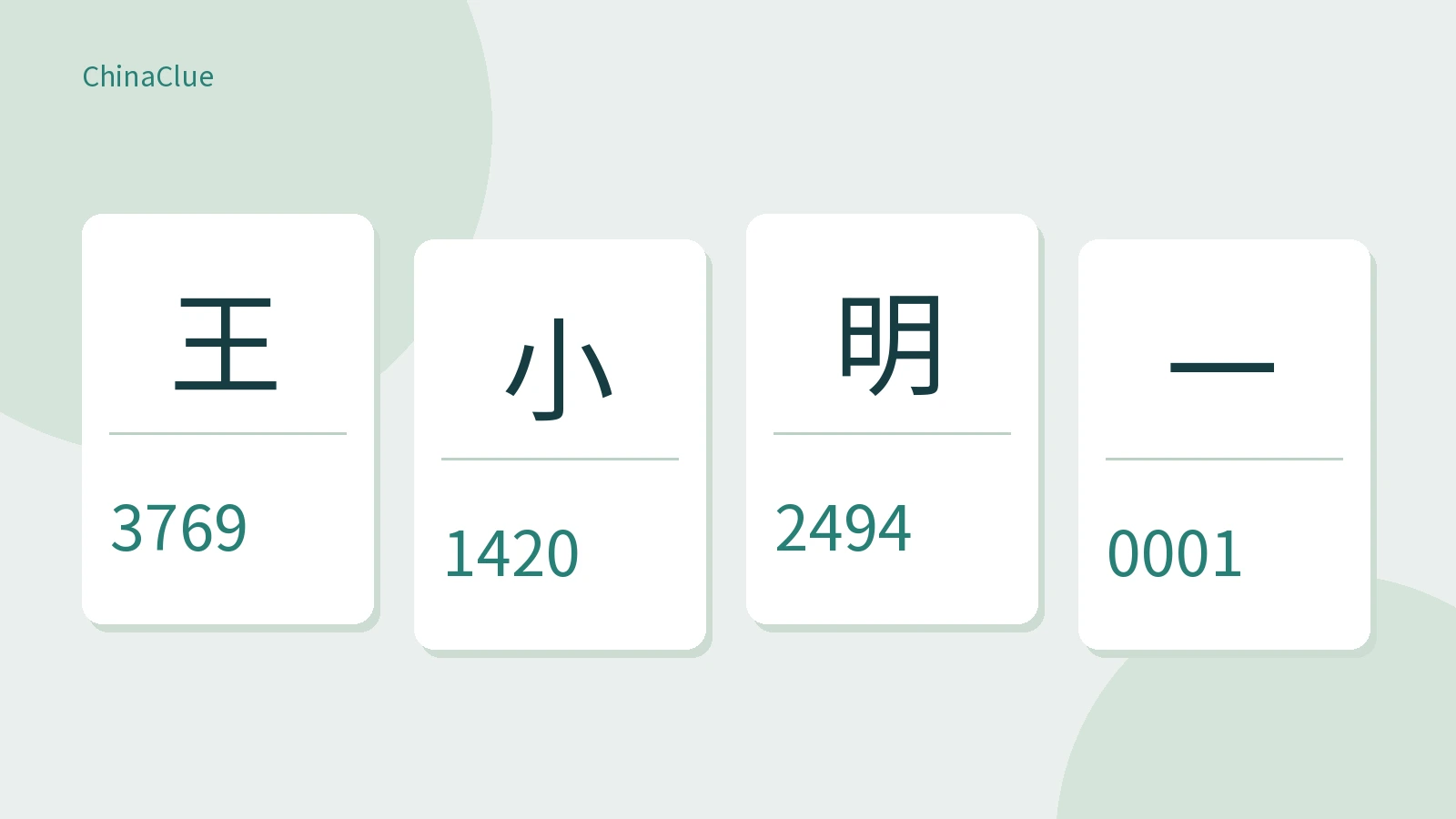
Keep the Chinese name, the Latin-script name and the telecodes as separate pieces of information. 王小明 is a written Chinese name; Wang Xiaoming is a possible Latin-script representation; 3769, 1420 and 2494 are the mainland-table codes for those three characters. One is not a formatting variant that can be pasted into any of the other fields.
For example, the US DS-160 help defines telecodes as four-digit numbers representing characters in some non-Roman names. Its passport-name instructions are a separate matter. Read the current field help and use the name spelling required by that form. Do not replace an established document spelling with pinyin generated from a lookup tool, or infer that a field must be completed simply because a code exists.
Choose a table before copying codes
The tool offers mainland and Taiwan mappings from a fixed Unicode Unihan 18.0.0 snapshot. Its coverage contains 7,078 characters with a mainland mapping and 9,024 with a Taiwan mapping, for 11,530 distinct characters across both. These are complete counts for those two source properties in that version, not a claim that every Chinese character has a telecode.
Choose the table required by the document or recipient. Do not switch tables merely to obtain a non-empty answer, and do not choose automatically from the language in which you are viewing the website. Table choice and page language are different decisions. If the form does not make the requirement clear, resolve that requirement before submitting a guessed code.
Character form matters. In this snapshot, 国 has mainland code 0948, while 國 has Taiwan code 0948. Their similar meaning does not make their source entries interchangeable. Another useful comparison is 万 and 萬: the Taiwan table gives 8001 for 万 and 5502 for 萬. Converting a whole name between simplified and traditional forms before checking can therefore change the character-to-code relationship.
Preserve the exact characters and leading zeros
Copy the Chinese name from the relevant record, then compare every character visually. Watch for a similar-looking character, a missing character or a different traditional form. The lookup does not silently convert simplified characters to traditional ones. A missing result should lead back to the written source and the selected table, not to an automatic replacement with a familiar character.
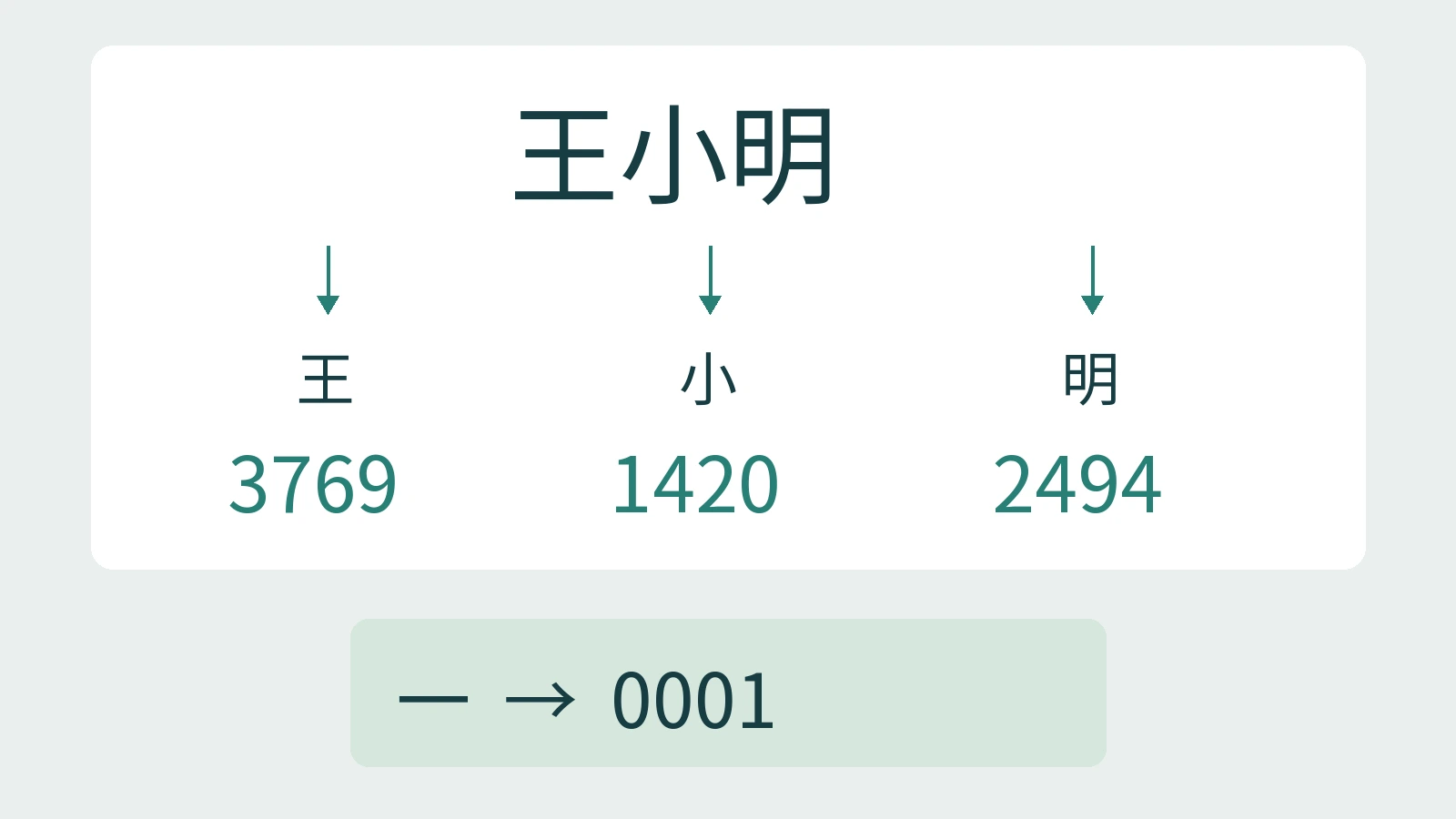
Keep each code as four digits. 一 maps to 0001; a spreadsheet that converts this to the number 1 has lost necessary formatting. Store the code column as text before pasting or importing, and inspect the actual saved value when transferring it to another file. Showing a number with four-digit display formatting is less robust than keeping the original text if a later export discards that formatting.
For the fictional name 王小明, check the pairs 王 → 3769, 小 → 1420 and 明 → 2494 before combining anything. Then follow the receiving form's instructions for separate surname and given-name fields, spaces or continuous digits. The tool's copied report includes the original character and its result for checking; it is not a promise that the whole report can be pasted unchanged into an application field.
Use reverse lookup as a checking step
Reverse lookup takes four-digit groups separated by spaces, commas or semicolons. Entering 3769 1420 2494 in the mainland table returns 王, 小 and 明 in that order. Entering one unseparated twelve-digit string is not the same input format. Keep the grouping visible in a working note even if the final form asks for continuous digits.
A round trip is useful for finding a transposed or mistyped code, but it is not proof of identity. Anyone can look up the same character, and the code does not identify a particular person. Where a mapping has more than one result, the tool keeps the alternatives rather than choosing a person or spelling for you. Resolve the written character against the source record.
Handle missing results before submission
If a character is not found, first check the exact character and the table selection. A rare character can be absent even when the table has been imported completely. A blank lookup is not evidence that the person's name is invalid. Do not invent a nearby code, drop that character or insert 0000 as a universal placeholder: the receiving organisation must specify how its form handles the case.
Keep a short working record containing the original name, chosen table, four-digit groups and any unresolved character. Recheck the final field after pasting, especially leading zeros and the division between surname and given name. The Chinese form-field reference helps keep name, address, telephone, postcode and other commonly confused fields separate while you prepare the information.
Comments
Loading…
No comments yet.